
Wheeler Board of Education Pass New Five-Year Strategic Plan
The Wheeler County Board of Education approved a new 51-page five-year strategic plan during their monthly meeting on Feb. 9 in the Wheeler County UGA Extension Office.
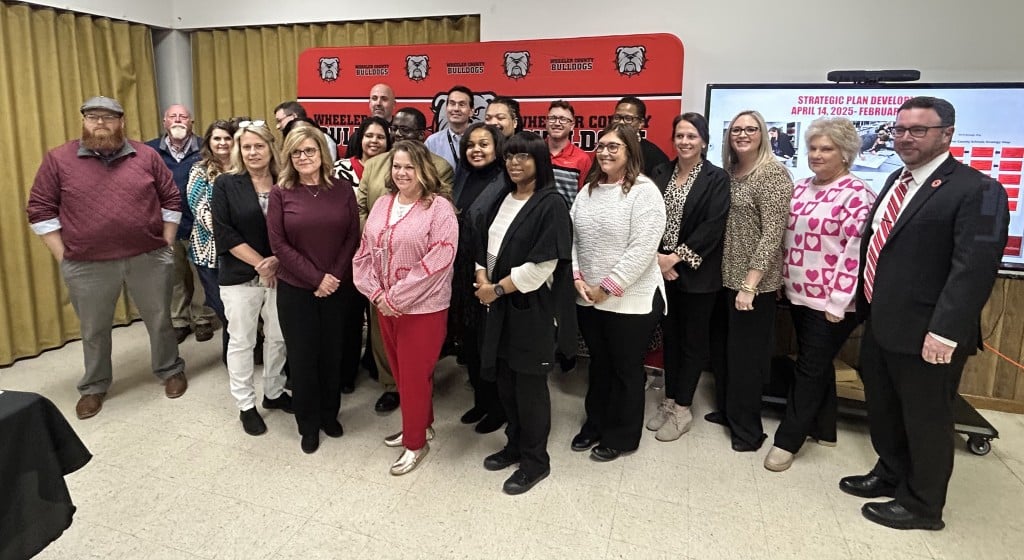
The Wheeler County Board of Education approved a new 51-page five-year strategic plan during their monthly meeting on Feb. 9 in the Wheeler County UGA Extension Office.
“It’s been a culmination of work of our board, of our community, of our district office staff, our school staff, our parent advisory council,” said Wheeler County Superintendent Dr. C. Alex Alvarez.
A strategic five-year plan is a document prepared by an organization or governing body detailing its plans and goals over the coming years. These plans are mandatory for entities such as local governments and school boards and play a pivotal role in acquiring funding.
The planning process began on April 14, 2025, with administrators and staff contributing to the process throughout the year. An initial draft was presented to the Board of Education in December, with feedback received in January.
The plan was structured around the schools’ five overarching goal areas, each given a designated committee of school staff members. Each goal area consists of three or four performance objectives with individual suggested metrics to gauge the plan’s success at fulfilling those goals.
The first goal area committee – student achievement and growth – consisted of Erin Beasley, Patricia Powell, Lea Hall, Kelly Blount, Bryant Oliver, Lori Adams, Chelsea Thomas and Alisa Edge. The committee was led by Melanie Knight.
“Their collaborative work, careful analysis and commitment to student success were instrumental in shaping this goal,” said Knight.
This goal area focuses on students’ academic success, aiming to impart curriculum mastery, provide instructional supports for literacy and ensure graduation and post-graduation readiness. According to the strategic plan, the school will accomplish this goal primarily by continuing and extending academic and career learning opportunities.
Key metrics for the first goal area include milestone scores, graduation rates, participation in dual enrollment and commitment to colleges or careers.
The second goal area committee – safe, caring and supportive schools – consisted of Lori Adams, Stephen Collins, Kevin Hammons, Gian Mancini, Wanda Solomon, Kim Stinson, Shanda Stokes and April Williams. The committee was led by Dr. Jenna Nobles.
“We focused on making sure that our students and our school campuses are safe, that we provide care and support for our students,” said Dr. Nobles.
The second goal area concerns itself with campus safety, including physical safety against potential threats as well as the mental and emotional well-being of students and staff. To that end, the plan aims to ensure students and staff are trained in safety procedures and implement policies to reduce student and staff absenteeism.
The third goal area committee – family and community partnerships – consisted of Mia Ingram, Cory Reynolds, Maria Ford, Drew Collins, Suzanne Couey, Ginger Horne and Jenny Pickle. The committee was led by Brandon Pope.
The longest section of the strategic plan, the third goal area is focused on engagement with the Wheeler County community, including parents, local businesses, civic groups and churches.
To connect to local organizations, the plan calls for establishing a community relations advisory team, church and pastor liaisons, an organizational advisory panel, an active parent teacher organization and a parent advisory council, alongside collaborations with Wheeler County Schools’ public relations and social media teams.
For parents, the schools plan to host more after-hours programming centered around academic support at home, skills and entertainment. The strategic plan also suggests a new “Parent Academy” initiative, which will include educational seminars for parents regarding vaping, bullying, digital footprints, mentorship programs with Brewton-Parker Christian University, and math and reading workshops for the elementary, middle and high schools.
The schools also plan to maintain a higher degree of communication with the community via newsletters and social media, as well as highlighting partnerships beneficial to students.
The fourth goal area committee – operational excellence and fiscal responsibility – consisted of Suzanne Couey, Janet Brown, Greg Wilcher, Melinda Horne, Tony Batchelor, Angie Mathis and Shonda McFadden. The committee was led by Quent Floyd.
“We work really well,” said Floyd. “I got the experts in those particular areas so that they could help make all of us work well and have good goals.”
The fourth goal area is the only goal to feature four performance objectives, all focused on optimizing facilities and financials.
For facilities, the plan calls for the development of maintenance and modernization plans for facilities and transportation. These plans also extend to surveillance and safety systems, custodial workers and school kitchens.
For financials, the schools plan to implement a three to five year financial projection model, as well as budget alignment reviews and greater emphasis on efficiency in regard to purchases. The schools will also strive for a greater degree of transparency towards stakeholders regarding school finances.
The goal area four committee also suggested streamlining internal processes and implementing technology to improve efficiency.
The fifth goal area committee – staff recruitment, retention and leadership development – consisted of Kim Stinson, Juaquita Williams, Philip Parker, David Copeland, Shonda McFadden, Shari Copeland, Ava Jones, Thomas Smith. The committee was led by William Bell.
“I had a great group of individuals who were trying to look for the future of Wheeler County schools,” said Bell.
The fifth goal area’s purview is twofold: the recruitment of new employees and the retention of current employees. Recruitment strategies listed by the strategic plan include a quarterly “Teach in Wheeler” spotlight, an expansion of the schools’ job fair participation and utilizing online spaces.
The plan also calls for the development of a “local teacher pipeline” which would encourage Wheeler County students to return to the school as teachers via scholarship and tuition reimbursement for returning graduates, recruitment stipends for college seniors and a “future educators” program for Wheeler County High School students.
The plan suggests offering staff certified salary steps, salary supplements, insurance and assistance with certification endorsements. However, certification endorsements would require a three year commitment.
In terms of retention, strategies include mentorship programs, improved morale and wellness initiatives and expanded leadership development.
The strategic plan passed with unanimous approval and will remain in place until 2031, when the Board will be required to create a new five-year strategic plan.
“It’s not something we’re going to try and accomplish at once, obviously,” said Dr. Alvarez. “Several areas have timelines included, but again, it helps keep us focused and transparent with our community, and again, keeping continuous improvement at the forefront.”
A copy of the strategic plan is available on the Wheeler County Schools website for public viewing.
Before you go...
Thanks for reading The Tri-County Connector. We hope this article added to your day.
We are a nonprofit, local newsroom that connects you to the whole story of Macon-Bibb County. We live, work and play here. We know Middle Georgia, and our reporting illuminates and celebrates the people and events that make this area unique.
If you appreciate what we do, please join the readers like you who help make our solution-focused journalism possible. Thank you
Related Articles
Work Begins on Soperton/Treutlen Recreation Department Renovations
Work has begun on the multi-phase renovation of Soperton and Treutlen County’s two recreation sites, a project stemming from community needs and community history.
City of Soperton Proclaims Easterseals Middle Georgia’s 50 Year Anniversary
The City of Soperton celebrated nonprofit Easter Seals of Middle Georgia with an official proclamation commemorating the organization’s 50 year anniversary.
Montgomery County Board of Education Debates Lawn Care Provider
The Montgomery County Board of Education considered several bids for a new lawn care provider for school grounds during their regular meeting on February 17 in the Board of Education Office’s auditorium.